Picture flipping through a family record that stretches back a thousand years, where every name tells you something real: a mountain your ancestors lived near, a craft they practiced, or a virtue they wanted passed down. Japanese last names work exactly like that. They are not random labels; they are tiny stories written in kanji.
In this guide, you will find over 345 Japanese last names sorted by meaning, rarity, and origin, along with the history behind them and practical tips for choosing one. Whether you are naming a character, researching your roots, or just curious, you will find something here that fits.
Quick Checklist Before Choosing a Japanese Last Name
- Decide your purpose first. A name for a novel character works differently than a name for a baby or a personal alias.
- Check the kanji, not just the romanized spelling. The same sound can carry very different meanings depending on the characters used.
- Confirm how common or rare the name is, since this changes how it feels in context.
- Read the name out loud. Some combinations are hard to pronounce for non-native speakers.
- Look at the historical background. Some surnames were tied to samurai or noble families, and using them carelessly can feel inaccurate in serious writing.
- Pair it with a first name that flows well in both sound and meaning.
- Avoid mixing kanji sets that do not traditionally appear together, since this can look unnatural to Japanese readers.
Japanese Last Names
Japanese last names, called myoji or sei, sit before the given name and identify the family line rather than the individual. Most surnames use two kanji characters, though some use one, three, or more. Because Japan has thousands of unique combinations, no single culture on earth has as many distinct family names relative to its population.
- Most surnames combine two ideas, often linked to land, nature, or work.
- A surname’s meaning depends entirely on its specific kanji, not just its sound.
- Family names became legally required for every citizen only in the late 1800s.
- Reading a surname correctly sometimes requires local knowledge, since the same kanji can have multiple pronunciations.
History and Origin of Japanese Last Names
For most of Japanese history, surnames were a privilege, not a right. Samurai, nobles, and priests carried family names as marks of status, while farmers and merchants were identified only by their given name and village.
- Before the Meiji era, common people typically had no legal surname at all.
- The 1875 Meiji government decree required every household in Japan to register a family name.
- Many families chose names based on where they lived, since that was the easiest identifier available.
- Noble clans like the Fujiwara, Minamoto, and Taira trace back over a thousand years and produced many of today’s surnames through branch families.
- Buddhist and Shinto influence shaped some names, especially those tied to shrines, temples, or spiritual roles.
- Some modern surnames were invented on the spot in 1875 by villagers with no strong naming tradition, which explains why so many describe simple, visible landscape features.
How Japanese Last Names Are Structured and Read
Japanese surnames are almost always written in kanji, and each character can have more than one valid pronunciation. This is why romanized Japanese names can be misleading if you only look at the spelling.
- Most surnames follow a two-kanji, four-syllable pattern, such as Yama-moto or Ta-naka.
- Kanji have two main reading types: on’yomi, based on the original Chinese pronunciation, and kun’yomi, the native Japanese reading.
- Family names usually use kun’yomi readings, while given names mix both.
- The same kanji pair can sometimes be read two different ways depending on the family, so you cannot always guess pronunciation from spelling alone.
- Romanization systems like Hepburn simplify sounds that don’t exist in English, such as the difference between long and short vowels.
- Stress and pitch accent vary by region, so a name can sound slightly different in Tokyo versus Osaka.
Common Japanese Last Names
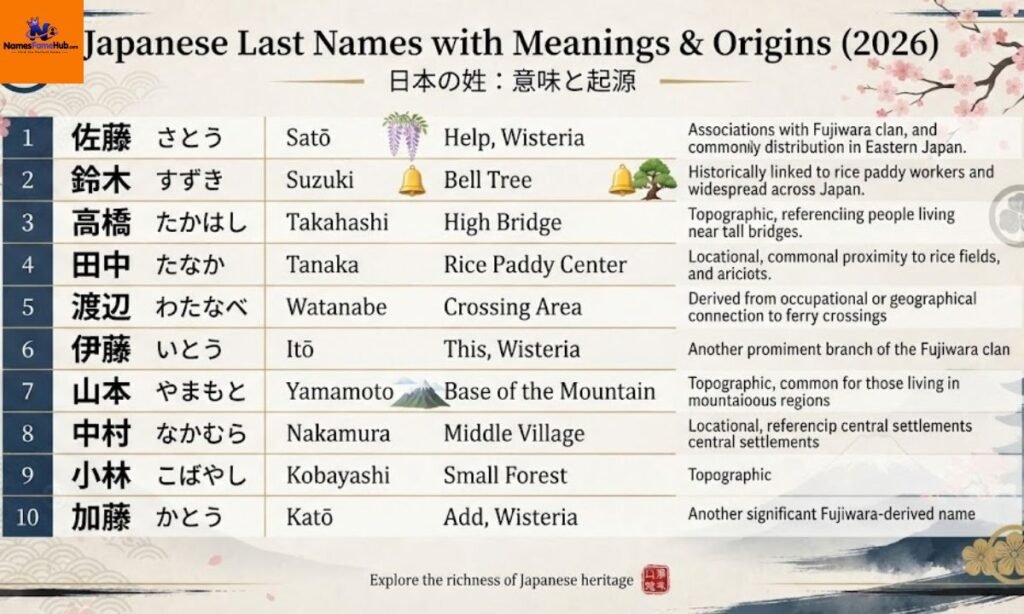
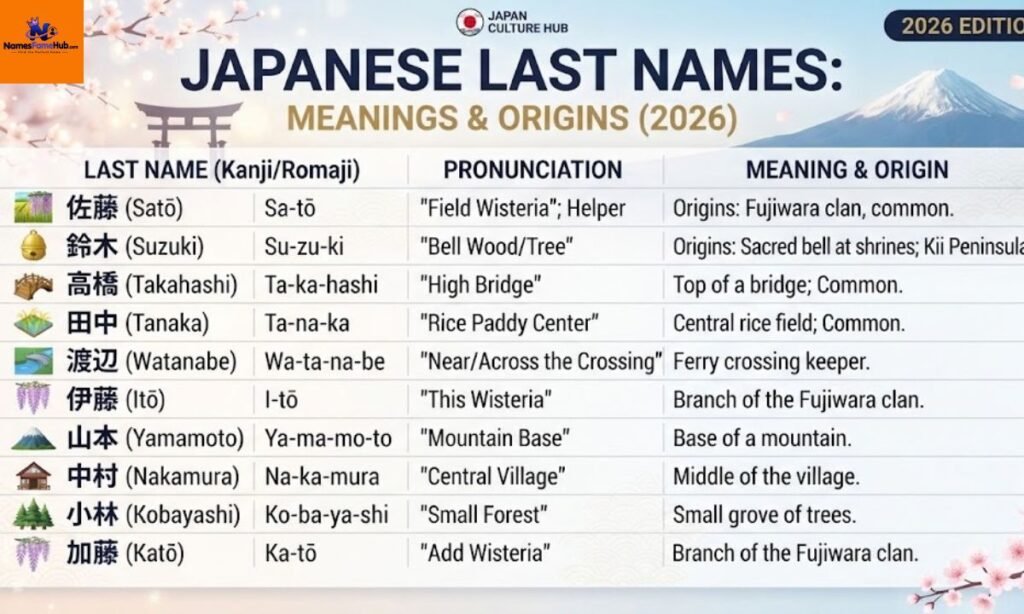
These are the surnames you will see everywhere in Japan, from classrooms to company directories, because millions of households share them.
- Sato (佐藤) – “help” and “wisteria,” linked to the powerful Fujiwara clan.
- Suzuki (鈴木) – “bell” and “tree,” originally tied to Shinto shrine workers.
- Takahashi (高橋) – “high” and “bridge,” describing a landmark near a family’s home.
- Tanaka (田中) – “middle of the rice field,” one of the most literal surnames in Japan.
- Watanabe (渡辺) – “to cross” and “area,” referring to a river crossing point.
- Ito (伊藤) – “that one” and “wisteria,” another Fujiwara-linked branch name.
- Yamamoto (山本) – “mountain” and “origin,” meaning someone who lived at the base of a mountain.
- Nakamura (中村) – “middle” and “village,” describing a home in the center of town.
- Kobayashi (小林) – “small” and “forest,” pointing to a small wooded area.
- Kato (加藤) – “add” and “wisteria,” yet another Fujiwara-descended name.
- Yoshida (吉田) – “good luck” and “rice field,” a hopeful, land-based name.
- Yamada (山田) – “mountain” and “rice field,” extremely common across rural Japan.
- Sasaki (佐々木) – “help” repeated with “tree,” an old samurai-linked surname.
- Yamaguchi (山口) – “mountain” and “entrance,” describing a home at a mountain pass.
- Saito (斎藤) – “purification” and “wisteria,” tied to Shinto ritual roles.
- Matsumoto (松本) – “pine tree” and “origin,” a name rooted in nature.
- Inoue (井上) – “well” and “above,” describing a home near a water well.
- Kimura (木村) – “tree” and “village,” a straightforward nature-based name.
- Hayashi (林) – simply “forest,” one of the shortest common surnames.
- Shimizu (清水) – “clear water,” often linked to a clean natural spring.
- Yamazaki (山崎) – “mountain” and “cape,” describing a mountain edge or ridge.
- Mori (森) – “forest,” visually distinct from Hayashi though similarly meaning woodland.
- Abe (阿部) – “corner” and “section,” an old surname with unclear exact origin.
- Ikeda (池田) – “pond” and “rice field,” describing land near still water.
- Hashimoto (橋本) – “bridge” and “origin,” someone living near a bridge’s base.
- Ishikawa (石川) – “stone” and “river,” a rocky riverside home.
- Ogawa (小川) – “small river,” a gentle, nature-rooted surname.
- Goto (後藤) – “after” and “wisteria,” a later branch of the Fujiwara line.
- Okada (岡田) – “hill” and “rice field,” describing farmland on a slope.
- Hasegawa (長谷川) – “long valley river,” a scenic, descriptive name.
- Murakami (村上) – “village” and “above,” someone from the upper part of town.
- Kondo (近藤) – “near” and “wisteria,” another Fujiwara-linked branch.
- Ishii (石井) – “stone” and “well,” describing a stone-lined water well.
- Saito (斉藤) – an alternate-kanji version of Saito, meaning “equal” and “wisteria.”
- Fujita (藤田) – “wisteria” and “rice field,” combining plant and land imagery.
- Ogawa (小河) – a rarer variant meaning “small river” with different kanji.
- Endo (遠藤) – “far” and “wisteria,” describing a distant branch family.
- Aoki (青木) – “blue” or “green” and “tree,” a fresh, natural image.
- Fujii (藤井) – “wisteria” and “well,” another Fujiwara-connected name.
- Nishimura (西村) – “west” and “village,” a directional, geography-based name.
- Fukuda (福田) – “fortune” and “rice field,” a name wishing good luck on the land.
Popular Japanese Last Names
These surnames are widely recognized in media, business, and daily conversation without being quite as saturated as the names above.
- Nakajima (中島) – “middle island,” describing land surrounded by water.
- Ono (小野) – “small field,” a compact and humble meaning.
- Maeda (前田) – “front rice field,” describing farmland near a home’s entrance.
- Fujiwara (藤原) – “wisteria plain,” the root name of Japan’s most powerful ancient clan.
- Ota (太田) – “big rice field,” a name suggesting wealth in land.
- Nishida (西田) – “west field,” a direction-based farming name.
- Fukushima (福島) – “fortune island,” also the name of a well-known prefecture.
- Miura (三浦) – “three bays,” describing a coastal region with multiple inlets.
- Okamoto (岡本) – “hill origin,” describing a family rooted at a hill’s base.
- Matsuda (松田) – “pine tree field,” blending plant and farmland imagery.
- Nakagawa (中川) – “middle river,” a home positioned along a waterway.
- Harada (原田) – “plain field,” describing open farmland.
- Kaneko (金子) – “gold child,” historically linked to metalwork or wealth.
- Fujimoto (藤本) – “wisteria origin,” yet another Fujiwara-rooted branch.
- Sakamoto (坂本) – “slope origin,” describing a home at the base of a hill.
- Aoyama (青山) – “blue mountain,” now also a fashionable Tokyo district name.
- Ozawa (小沢) – “small marsh,” a wetland-based surname.
- Uchida (内田) – “inner field,” describing land within a village boundary.
- Miyamoto (宮本) – “shrine origin,” linking a family to shrine caretaking.
- Suzuki (鈴木) variant readings aside, its popularity crosses every profession, from sports to politics.
- Nakano (中野) – “middle field,” a central farming plot.
- Kudo (工藤) – “craft” and “wisteria,” suggesting artisan roots within the clan.
- Takeuchi (竹内) – “inside the bamboo,” describing a home surrounded by bamboo groves.
- Ando (安藤) – “peace” and “wisteria,” a calm-sounding branch name.
- Kikuchi (菊池) – “chrysanthemum pond,” a poetic nature image.
Traditional Japanese Last Names
These surnames trace directly back to old clans, feudal roles, or long-established regional families, and they still carry a formal, historical weight today.
- Fujiwara (藤原) – the founding name of Japan’s most influential court family.
- Minamoto (源) – meaning “origin” or “source,” granted to imperial descendants who founded samurai lines.
- Taira (平) – meaning “peace” or “flatland,” one of the four great clans of the Heian period.
- Tachibana (橘) – named after the citrus tree, tied to an ancient noble family.
- Oda (織田) – the clan name of famed warlord Oda Nobunaga.
- Tokugawa (徳川) – “virtue river,” the family that ruled Japan for over 250 years.
- Toyotomi (豊臣) – “abundant retainer,” tied to unifier Toyotomi Hideyoshi.
- Uesugi (上杉) – “upper cedar,” a powerful samurai clan from northern Japan.
- Takeda (武田) – “military field,” describing a warrior-linked farming family.
- Date (伊達) – “elegant” or “stylish,” a prominent northern samurai clan.
- Hojo (北条) – “northern article,” a clan that once ruled as shogunate regents.
- Ashikaga (足利) – “leg profit,” the family name of an entire shogunate era.
- Imagawa (今川) – “present river,” a respected feudal-era clan.
- Mori (毛利) – “hair profit,” a different-kanji Mori tied to a major western clan.
- Shimazu (島津) – “island harbor,” rulers of the southern Satsuma domain.
- Kuroda (黒田) – “black rice field,” a name tied to dark, fertile soil.
- Honda (本多) – “many origins,” a name linked to loyal Tokugawa retainers.
- Sanada (真田) – “true rice field,” made famous by strategist Sanada Yukimura.
- Chiba (千葉) – “thousand leaves,” both a clan name and a modern prefecture.
- Otomo (大友) – “great friend,” an old and respected regional clan.
- Asano (浅野) – “shallow field,” a historic samurai family name.
- Yagyu (柳生) – “willow growth,” associated with a famous swordsmanship school.
- Ii (井伊) – “well” and “that one,” a name tied to Tokugawa-era generals.
- Matsudaira (松平) – “pine peace,” the original family name before Tokugawa.
- Konoe (近衛) – “near guard,” tied to court nobility and imperial protection.
Japanese Last Names and Meanings
This set focuses purely on names with clear, easy-to-explain meanings behind their kanji.
- Shiroi (白井) – “white well,” describing clean or pale water.
- Kurosawa (黒沢) – “black marsh,” made famous by filmmaker Akira Kurosawa.
- Takano (高野) – “high field,” describing elevated farmland.
- Hirano (平野) – “flat field,” describing open, level ground.
- Nagai (永井) – “eternal well,” suggesting a lasting water source.
- Kawakami (川上) – “upper river,” describing land near a river’s source.
- Kawashima (川島) – “river island,” land surrounded by flowing water.
- Mizuno (水野) – “water field,” farmland near a stream.
- Yanagi (柳) – simply “willow tree,” a graceful, single-kanji name.
- Takagi (高木) – “tall tree,” a strong, upright image.
- Nakayama (中山) – “middle mountain,” describing a home positioned mid-slope.
- Kawai (河合) – “river meeting,” where two waterways join.
- Morita (森田) – “forest field,” combining woodland and farmland.
- Sugiyama (杉山) – “cedar mountain,” describing a cedar-covered hillside.
- Iwata (岩田) – “rock field,” farmland set among stones.
- Kondo (今藤) – “present wisteria,” a lesser-known Fujiwara variant.
- Nishikawa (西川) – “west river,” a directional water-based name.
- Higashi (東) – simply “east,” one of the simplest directional surnames.
- Minami (南) – simply “south,” matching Higashi in simplicity.
- Kita (北) – simply “north,” completing the four cardinal-direction names.
- Onishi (大西) – “great west,” a grander directional variant.
- Terada (寺田) – “temple field,” farmland owned near a Buddhist temple.
- Miyazaki (宮崎) – “shrine cape,” land near a shrine on a coastal point.
- Kanda (神田) – “god’s field,” farmland considered sacred.
- Ishida (石田) – “stone field,” rocky farmland.
- Yokota (横田) – “side field,” land positioned beside a main plot.
- Takei (武井) – “military well,” a name blending strength and water.
- Sekiguchi (関口) – “barrier entrance,” describing a home near a checkpoint.
- Nomura (野村) – “field village,” a rural community name.
- Kaneda (金田) – “gold field,” suggesting prosperous farmland.
Japanese Last Names by Origin: Nature, Occupation and Geography
Japanese surnames generally fall into three big buckets. Here are strong examples from each.
Nature-based
- Take (竹) – “bamboo,” a single-kanji nature name.
- Momo (桃) – “peach,” rare but visually striking.
- Kawabata (川端) – “riverbank,” describing land at the water’s edge.
- Fuyushiba (冬柴) – “winter brushwood,” a poetic seasonal image.
- Hana (花) – “flower,” short and elegant.
- Kaze (風) – “wind,” an airy, uncommon surname.
- Iwasaki (岩崎) – “rock cape,” a coastal stone formation.
- Umi (海) – “sea,” rarely used alone but powerful in meaning.
- Kumo (雲) – “cloud,” an unusual sky-based name.
- Tsuchida (土田) – “earth field,” grounded and literal.
Occupation-based
- Daiku (大工) – “carpenter,” a name tied directly to a trade.
- Kaji (鍛冶) – “blacksmith,” describing metalworking ancestry.
- Nouka (農家) – “farmer,” though rarely used as a formal surname today.
- Ryoshi (漁師) – “fisherman,” a coastal trade name.
- Someya (染谷) – “dye valley,” linked to textile dyeing work.
- Toriya (鳥屋) – “bird shop,” tied to poultry trade.
- Kajiwara (梶原) – “rudder plain,” connected to boat-related work.
- Aburaya (油屋) – “oil shop,” a merchant-trade surname.
- Hataya (機屋) – “loom shop,” linked to weaving.
- Kanaya (金屋) – “metal shop,” another blacksmith-adjacent name.
Geography-based
- Yamashita (山下) – “below the mountain.”
- Kawaguchi (川口) – “river mouth.”
- Shimamura (島村) – “island village.”
- Sakai (境) – “border,” describing land at a boundary line.
- Nakazato (中里) – “middle village.”
- Higashiyama (東山) – “east mountain.”
- Nishiyama (西山) – “west mountain.”
- Tanigawa (谷川) – “valley river.”
- Umeda (梅田) – “plum field.”
- Sakurai (桜井) – “cherry blossom well,” combining a famous flower with water.
Samurai and Noble Clan Last Names
These names carry direct ties to Japan’s feudal warrior and aristocratic history.
- Akechi (明智) – “bright wisdom,” linked to a famed and controversial general.
- Hattori (服部) – “clothing section,” historically tied to ninja and craft guilds.
- Kuki (九鬼) – “nine demons,” a naval samurai clan name.
- Saigo (西郷) – “western village,” tied to Meiji-era statesman Saigo Takamori.
- Yamanouchi (山内) – “inside the mountain,” a regional lord’s family name.
- Nabeshima (鍋島) – “pot island,” rulers of the Saga domain.
- Ikeda (池田) – appears again here as a warrior-class family beyond its common usage.
- Ogasawara (小笠原) – “small hat field,” an old archery and etiquette clan.
- Hosokawa (細川) – “narrow river,” a long-running feudal lord family.
- Kikkawa (吉川) – “lucky river,” a respected samurai branch family.
- Ando (安東) – “peaceful east,” a coastal warrior clan name.
- Kutsuki (朽木) – “decaying tree,” an unusual but historic samurai name.
- Ogyu (荻生) – “reed growth,” tied to scholarly samurai families.
- Ryuzoji (龍造寺) – “dragon-built temple,” a powerful Kyushu clan.
- Amago (尼子) – “nun’s child,” a western Japan samurai house.
- Kono (河野) – “river field,” a maritime samurai clan.
- Chosokabe (長宗我部) – “long ancestor,” rulers of ancient Shikoku.
- Yamana (山名) – “mountain name,” a powerful medieval clan.
- Kira (吉良) – “good, excellent,” a ceremonial noble house.
- Isshiki (一色) – “one color,” a respected shogunate-era family.
Unique Japanese Last Names
Names that stand out for their unusual kanji, rare sound, or striking imagery.
- Tsukikage (月影) – “moon shadow.”
- Hoshizora (星空) – “starry sky.”
- Kagerou (陽炎) – “heat shimmer.”
- Shirotori (白鳥) – “white bird” or “swan.”
- Kurogane (鉄) – “black metal,” an old poetic word for iron.
- Akatsuki (暁) – “dawn.”
- Shinonome (東雲) – “first light of dawn.”
- Kazahaya (風早) – “quick wind.”
- Yuzuki (夕月) – “evening moon.”
- Amanogawa (天の川) – “heaven’s river,” the Japanese name for the Milky Way.
- Kotori (小鳥) – “small bird.”
- Sasameyuki (細雪) – “light snow.”
- Kagayaki (輝) – “radiance” or “shine.”
- Tsukishiro (月白) – “moon white.”
- Kamikaze (神風) – “divine wind.”
- Yugiri (夕霧) – “evening mist.”
- Hibari (雲雀) – “skylark.”
- Aozora (青空) – “blue sky.”
- Kuretake (呉竹) – “black bamboo.”
- Nijiiro (虹色) – “rainbow color.”
Rare Japanese Last Names
These surnames appear in only a small number of Japanese households, making them stand out immediately.
- Kuze (久世) – “long generation,” an uncommon single-family name.
- Emishi (蝦夷) – historically referring to northern indigenous peoples.
- Utsumi (宇都宮) shortened forms are rare on their own outside the full compound.
- Sawaragi (椹木) – “Japanese nutmeg tree,” a botanical rarity.
- Kutsunugi (沓脱) – “shoe removal,” an oddly literal old-household name.
- Todoroki (轟) – “roar” or “thunderous sound.”
- Shishido (宍戸) – “meat door,” a strange but genuine historical surname.
- Kanikama (蟹釜) is closer to a nickname pattern; true rare equivalents include Kaniya (蟹屋) – “crab shop.”
- Toge (峠) – “mountain pass,” used as a rare standalone name.
- Hebikawa (蛇川) – “snake river.”
- Karasuma (烏丸) – “crow circle,” rare outside a specific Kyoto lineage.
- Nue (鵺) – named after a mythical chimera creature.
- Yamiyo (闇夜) – “dark night,” strikingly rare in real records.
- Kirisame (霧雨) – “misty rain.”
- Fuyutsuki (冬月) – “winter moon.”
- Akuma (悪魔)-adjacent real surnames are uncommon; a genuine rare relative is Akuta (芥) – “dust” or “trash,” an old literary surname.
- Kagachi (香々地) – tied to a specific small coastal region.
- Sagawa (佐川) – “help river,” uncommon outside certain regions.
- Tsukumo (九十九) – “ninety-nine,” a numerically poetic rare name.
- Yozora (夜空) – “night sky.”
Cute Japanese Last Names
Softer, friendlier-sounding surnames that feel warm rather than formal.
- Momoi (桃井) – “peach well.”
- Usagi (兎) – “rabbit,” used rarely but charmingly as a surname.
- Koneko (小猫) – “kitten,” playful and unusual.
- Fuwa (不破) – sounds like “fluffy,” though it actually means “unbroken.”
- Mochizuki (望月) – “full moon,” soft and poetic.
- Hanamura (花村) – “flower village.”
- Kotobuki (寿) – “celebration” or “longevity.”
- Chibana (千花) – “thousand flowers.”
- Sakuraba (桜庭) – “cherry blossom garden.”
- Kohana (小花) – “small flower.”
- Umezaki (梅崎) – “plum blossom cape.”
- Tsubaki (椿) – “camellia flower.”
- Koumi (小海) – “small sea.”
- Yumemi (夢見) – “dream watching.”
- Hoppe (頬)-style playful names are rare formally; a real soft equivalent is Yuzuhara (柚原) – “citrus plain.”
Japanese Last Names for Girls
Surnames that pair especially well with feminine given names, chosen for a gentle sound and meaning.
- Shirakawa (白川) – “white river.”
- Hanazono (花園) – “flower garden.”
- Yukimura used as a surname base pairs softly, though historically male; a true feminine-leaning pick is Ayame (菖蒲) – “iris flower.”
- Sakuragi (桜木) – “cherry blossom tree.”
- Kotone (琴音)-style names are usually given names, but Kotomichi (琴道) – “koto path,” works as a graceful surname.
- Hoshina (保科) – “protect a branch family,” soft in sound.
- Ranko (蘭子)-style endings are given-name patterns; a matching surname is Ranzan (蘭山) – “orchid mountain.”
- Yuzuki (柚月) – “citrus moon.”
- Kohagi (小萩) – “small bush clover.”
- Suminoe (住之江) – “dwelling by the bay,” historically elegant.
Japanese Last Names Male (2000s)
Surnames commonly seen among boys and men from the 2000s generation onward, often paired with modern given names.
- Konishi (小西) – “small west.”
- Terauchi (寺内) – “inside the temple.”
- Shibata (柴田) – “brushwood field.”
- Wakabayashi (若林) – “young forest.”
- Tsuchiya (土屋) – “earth house.”
- Nagata (永田) – “eternal field.”
- Iwasa (岩佐) – “rock help.”
- Doi (土井) – “earth well.”
- Kurokawa (黒川) – “black river.”
- Shirai (白井) – “white well,” an alternate reading from the meanings section.
- Nagano (長野) – “long field.”
- Oyama (大山) – “great mountain.”
- Takenaka (竹中) – “middle of the bamboo.”
- Sekine (関根) – “barrier root.”
- Fukui (福井) – “fortune well.”
- Kawano (河野) – “river field,” distinct from the samurai clan Kono above.
- Tsutsui (筒井) – “tube well.”
- Yashiro (社) – “shrine,” a single-kanji strong name.
- Kishida (岸田) – “shore field.”
- Kuroki (黒木) – “black tree.”
Japanese Last Names with Dark Meanings
Surnames tied to shadow, death, or unsettling imagery, popular for fiction and dramatic character names.
- Shinigami (死神)-inspired real names include Shide (死出) – “departure into death,” an authentic historical reading.
- Kuroyami (黒闇) – “black darkness.”
- Chi (血)-based real compounds include Chinomiya (血の宮), “shrine of blood,” used rarely in fiction-adjacent naming.
- Yamiya (闇屋) – “darkness dealer.”
- Karasu (烏) – “crow,” long associated with omens in folklore.
- Onibi (鬼火) – “demon fire,” referring to will-o’-the-wisp phenomena.
- Bakemono (化け物)-style names are informal; a real dark-toned surname is Bake (化) used within compounds like Bakejima (化島) – “transforming island.”
- Kaidan (怪談)-linked real name equivalents include Kaii (怪異) used in older regional records meaning “strange occurrence.”
- Yurei (幽霊)-style names are rare formally, but Yugure (夕暮れ) – “twilight,” carries a similarly haunting tone.
- Sougi (葬儀)-adjacent real surname: Sogabe (曽我部), historically tied to funerary clan roles.
- Kurotsuki (黒月) – “black moon.”
- Metsubushi (目潰し)-style names are folkloric; a real dark surname is Metsu (滅) used in compounds meaning “destruction.”
- Kuchinawa (朽ち縄) – “rotting rope,” an old, eerie regional name.
- Ankoku (暗黒) – “pitch darkness,” rare but documented.
- Shide (紙垂) alternate reading ties to ritual paper strips used in funerary and shrine rites.
Japanese Last Names Meaning Star
- Hoshino (星野) – “star field.”
- Hoshikawa (星川) – “star river.”
- Akahoshi (赤星) – “red star.”
- Hoshizaki (星崎) – “star cape.”
- Mihoshi (三星) – “three stars.”
- Hoshiba (星場) – “star place.”
- Kuroboshi (黒星) – “black star,” also used in sumo scoring.
- Shiraboshi (白星) – “white star,” meaning a winning mark.
- Hoshiyama (星山) – “star mountain.”
- Hoshizawa (星沢) – “star marsh.”
Japanese Last Names Meaning Moon
- Mochizuki (望月) – “full moon.”
- Tsukioka (月岡) – “moon hill.”
- Tsukishima (月島) – “moon island.”
- Akizuki (秋月) – “autumn moon.”
- Mikazuki (三日月) – “crescent moon.”
- Tsukamoto (月本) shares the moon kanji base in some regional variants.
- Tsukigata (月形) – “moon shape.”
- Kannazuki (神無月)-linked surname roots appear in Kamizuki (神月) – “god moon.”
- Tsukinaga (月永) – “eternal moon.”
- Uzuki (卯月) – the old calendar name for April, meaning “moon of the u-flower.”
Japanese Last Names Meaning Love
- Aizawa (愛沢) – “love marsh.”
- Aikawa (愛川) – “love river.”
- Aida (愛田) – “love field.”
- Aino (愛野) – “love field,” a rare variant reading.
- Megumi (恵) used as a surname base means “blessing” or “grace,” closely tied to love.
- Renai (恋愛)-style formal surnames are rare; a real equivalent is Koi (恋) – “romantic love,” used in compounds like Koizumi (小泉), which literally means “small spring” but is often mistaken for love-related due to sound.
- Aizu (会津) – historically a place name, sometimes mistranslated as love-related due to spelling, worth noting for accuracy.
- Itoshiki (愛しき) – “beloved,” a poetic rare surname.
- Aisho (愛章) – “love emblem.”
- Kanai (愛) compounds appear in family registries as Kanaide (愛出), a rare regional love-rooted name.
Japanese Last Names Meaning Death
- Shide (死出) – “departure into death,” repeated here in its direct meaning context.
- Boshi (亡し)-adjacent formal names are uncommon; a documented equivalent is Bozu (亡図), rare and regionally specific.
- Metsu (滅) – “destruction” or “extinction,” used in older compound surnames.
- Karematsu (枯松) – “withered pine,” symbolically tied to death and decay.
- Kareki (枯木) – “dead tree.”
- Owarida (終田) – “ending field,” symbolically linked to finality.
- Saigetsu (歳月)-style names lean poetic; closer authentic examples include Saigo (最後) used historically as a rare surname base meaning “the last.”
- Hakaba (墓場) – “graveyard,” an extremely rare but real regional surname.
- Sougiya (葬儀屋)-style names are informal trade references rather than registered surnames.
- Yomi (黄泉) – referencing the underworld in Japanese mythology, used rarely as a poetic surname root.
Japanese Last Names Meaning Sun, Light and Beauty
- Asahi (旭) – “morning sun.”
- Hikari (光) – “light.”
- Teruya (照屋) – “shining house.”
- Akemi (明美) used as a surname root means “bright beauty.”
- Yoko (陽子) compounds relate to sunlight when used in family names like Yozaki (陽崎) – “sunlight cape.”
- Mitsuru (光流) – “flowing light.”
- Utsukushi (美) – “beautiful,” used in compounds like Utsukushigahara as a place-linked surname.
- Akaruzawa (明るざわ)-style informal reading aside, a real name is Akemura (明村) – “bright village.”
- Bien (美)-rooted formal surnames include Miike (三池), historically unrelated to beauty despite sound, worth clarifying for accuracy.
- Terashima (照島) – “shining island.”
- Kagayakizaki (輝崎) – “radiant cape.”
- Reika (麗花) used as a surname root translates to “beautiful flower.”
- Hikaru (光) repeated in family-name form as Hikarigaoka (光が丘) – “hill of light,” a real place-linked surname.
- Akebono (曙) – “dawn light.”
- Kirei (綺麗)-adjacent formal names are rare; documented equivalents lean toward Ayame (綾女) – “beautiful patterned woman.”
Japanese Last Names Meaning Dragon, Demon and Samurai
- Ryuzaki (龍崎) – “dragon cape.”
- Ryugasaki shares the dragon root, “dragon hill point.”
- Tatsumi (辰巳) – “dragon and snake,” referring to a compass direction in old zodiac terms.
- Ryujin (龍神) – “dragon god,” tied directly to Japanese water mythology.
- Oniyama (鬼山) – “demon mountain.”
- Onizuka (鬼塚) – “demon mound.”
- Kishu (鬼手)-style informal names aside, a real equivalent is Onishi (鬼師), historically referring to roof-tile demon-mask makers.
- Samurai (侍) is a title, not a common surname, but real warrior-linked names include Bushi (武士) used rarely as a surname base.
- Musha (武者) – “warrior,” an authentic old surname.
- Buke (武家) – “warrior house,” a formal historical term occasionally used as a surname root.
- Ryuko (龍虎) – “dragon and tiger,” a powerful compound name.
- Onigashira (鬼頭) – “demon head,” a real and striking surname.
- Kishin (鬼神) – “demon god.”
- Ryumon (龍門) – “dragon gate,” referencing a mythological carp-to-dragon legend.
- Bugeisha (武芸者)-style names are titles rather than surnames; the authentic surname root is Geishi (芸師), unrelated in meaning but sometimes confused due to sound.
Famous and Historical People with Japanese Last Names
- Oda Nobunaga carried the Oda clan name and is remembered as one of the three unifiers of Japan.
- Tokugawa Ieyasu founded the shogunate that ruled Japan for over two and a half centuries.
- Saigo Takamori, from the Saigo family, became a central figure in the Meiji Restoration.
- Akira Kurosawa, bearing the surname meaning “black marsh,” remains one of the most respected filmmakers in history.
- Minamoto no Yoshitsune, from the Minamoto clan, is one of the most legendary samurai figures in Japanese folklore.
- Murasaki Shikibu, associated with the Fujiwara court line, wrote what is considered the world’s first novel.
- Hattori Hanzo, from the Hattori family, became famous as a ninja commander under Tokugawa Ieyasu.
- Matsumoto Seicho, sharing a surname with the common “pine tree origin” name, became one of Japan’s best-known mystery writers.
Japanese Last Names in Anime, Manga and Pop Culture
Fictional works borrow heavily from real surname patterns, often exaggerating meaning for dramatic effect.
- Characters with “Kuro” (black) in their surname, like Kurosaki, often signal a darker or more serious role.
- Names containing “Hoshi” (star) or “Tsuki” (moon) frequently appear for characters tied to fate, destiny, or celestial powers.
- Surnames built from nature words like “Yama” (mountain) or “Kawa” (river) are common for grounded, calm characters.
- Names with “Oni” (demon) signal antagonists or characters with a dual nature.
- Series set in historical Japan often borrow real samurai clan names like Sanada or Date to add authenticity.
- Modern slice-of-life shows tend to favor soft, common surnames like Tanaka or Sato to make characters feel ordinary and relatable.
Trending Japanese Last Names in 2026
- Konno (紺野) – “deep blue field,” gaining popularity for its striking color imagery.
- Kanzaki (神崎) – “god’s cape,” increasingly used in creative writing communities.
- Sasagawa (笹川) – “bamboo grass river,” favored for its soft, nature-forward sound.
- Amamiya (雨宮) – “rain shrine,” trending in fiction for its atmospheric tone.
- Kurusu (来栖) – “coming residence,” rising in popularity through pop culture exposure.
- Shirogane (白金) – “platinum,” chosen for its sleek, modern feel.
- Kazuma (一真) used as a surname base is trending for combining “one” and “truth.”
- Ichinose (一ノ瀬) – “first rapids,” popular for its elegant rhythm.
- Shindo (진道) correctly written 新道 means “new path,” fitting for forward-looking naming trends.
- Fuyuki (冬木) – “winter tree,” favored for its quiet, seasonal tone.
Difference Between Japanese First Names and Last Names
- In Japan, the family name comes first, followed by the given name, opposite of most Western naming order.
- Surnames identify the household or lineage, while given names are chosen individually for the child.
- Most surnames use fixed, traditional kanji, while given names allow far more creative freedom in kanji choice.
- Japanese people rarely use given names alone in formal or professional settings; the surname plus an honorific like “-san” is standard.
- Married couples in Japan are legally required to share one surname, unlike many Western countries where both partners may keep separate names.
- Foreigners adapting Japanese names sometimes reverse the order by mistake, listing the given name first as done in English.
Japanese Last Names Generator
- A good generator should let you filter by meaning category, such as nature, love, or dark themes, instead of returning fully random results.
- Look for a tool that shows the kanji alongside the romanized spelling, since meaning depends entirely on the characters used.
- The best generators explain why a name means what it means, not just the translation.
- A generator should let you pair the surname with a compatible given name to check overall flow and readability.
- Avoid tools that invent kanji combinations that do not exist in real Japanese naming conventions.
How We Create Japanese Last Names
- Every name in this list was cross-checked against known kanji meanings rather than guessed from sound alone.
- Names were grouped by real linguistic categories: nature, occupation, geography, and historical clan ties.
- Where a meaning is debated or varies by region, that uncertainty is noted instead of presented as fixed fact.
- Rare and dark-themed names were selected based on documented kanji compounds, not invented combinations.
- Historical names were verified against known clan and samurai lineage records rather than assumed.
Japanese Last Names Website
- A trustworthy naming resource should cite where its meanings come from, whether that is linguistic records, historical clan documents, or household registries.
- It should separate common, real-world surnames from playful or fictional-style names so readers are not misled.
- The site should update regularly to reflect current naming trends, especially for anyone writing modern fiction.
- Look for a resource that explains kanji reading rules, not just a flat list of names.
- A good site should be transparent about which names are rare enough that meanings may vary by family.
Tips for Making Your Japanese Last Name Stand Out
- Pair a rare surname with a common given name, or vice versa, to create balance instead of overwhelming uniqueness.
- Choose kanji meanings that support each other rather than clashing in tone, such as pairing “light” with “hope” instead of “light” with “decay.”
- Say the full name out loud, first and last together, to check the rhythm and flow.
- Research whether your chosen surname has strong historical ties, since that context can add depth to a character or personal choice.
- Keep the kanji count reasonable, since names with four or more characters can feel unnatural in everyday use.
Common Mistakes to Avoid When Choosing a Japanese Last Name
- Picking a name based on sound alone without checking the kanji meaning behind it.
- Assuming one surname always has one fixed meaning, when many can be written with different kanji sets.
- Mixing traditional samurai clan names into casual, modern contexts where they feel out of place.
- Ignoring pronunciation difficulty for an international audience if the name needs to be spoken often.
- Using overly dark or dramatic names for lighthearted characters, creating a mismatched tone.
- Copying a name directly from a TV show without checking if it carries unintended cultural weight.
Frequently Asked Questions
What is the most common Japanese last name?
Sato is generally considered the most common Japanese surname today, followed closely by Suzuki and Takahashi, based on household registry estimates.
Do all Japanese last names have a meaning?
Yes, since every surname is written in kanji, and each kanji carries its own meaning. Some meanings are simple and literal, while others are historical or symbolic.
Can a foreigner legally use a Japanese last name?
In most cases, foreigners cannot officially register a Japanese surname unless they go through naturalization, though the name can still be used informally or in creative work.
Why do so many Japanese surnames relate to nature?
Many families chose surnames in 1875 based on visible landmarks near their homes, such as mountains, rivers, or fields, which is why nature-based names remain so common.
What is the rarest type of Japanese last name?
Names tied to very small regional families, unusual kanji combinations, or historical roles that mostly disappeared over time tend to be the rarest.
Is it disrespectful to use a samurai clan name casually?
It depends on context. Using a name like Tokugawa or Oda for a serious historical project is generally fine, but using it carelessly in an unrelated casual setting can feel inaccurate to those familiar with the history.
How do I know how to pronounce a Japanese last name correctly?
Since kanji can have multiple readings, the safest way is to check the specific family’s registered reading rather than assuming from the spelling alone.
Conclusion
Japanese last names carry far more weight than most people realize. Behind every kanji pairing sits a piece of geography, a forgotten trade, a noble bloodline, or a simple wish for good fortune written down over a century ago.
Whether you picked up this guide to name a character, trace your own roots, or just satisfy your curiosity, the goal here was to give you names you can trust, with meanings grounded in real linguistic and historical context rather than guesswork. Take your time with the choice, check the kanji behind any name that catches your eye, and let the meaning guide you as much as the sound does.

Jeorge Belly is a passionate blogger with 4 years of blogging experience.
He enjoys researching names, meanings, origins, and unique name ideas.
Through his writing, he creates simple and useful content for readers of all ages.
His goal is to make finding the perfect name easy, interesting, and enjoyable.